The question people most often ask Anuradha Banerji Sarkar, once they have come to know her a little, is this: why psychology? Why the mind, when medicine seemed the more obvious path for someone with her ability, her care, and her deep desire to help people? Her answer is considered, precise, and has not changed in 35 years: because the mind is where most human suffering begins, and therefore where most human healing must start.
This is the story of how she came to that understanding — and what it has meant for the thousands of lives she has touched in South Delhi and beyond.
An Early Calling — The Child Who Listened
Growing up in Kolkata, Anuradha was always the person people came to. Not because she was the most accomplished in the room, or the most authoritative, but because she had a quality that is rarer than either of those things: she genuinely listened. Not to formulate a response, not to assess or evaluate, but to understand. To receive what was being shared with the kind of full, unhurried attention that most people experience very rarely, if at all, in the course of an ordinary life.
She did not have words for this quality then. She simply knew that when someone came to her with something difficult, she felt the natural thing to do was to be still with it — to not rush to fix it or explain it away, but to sit with it and with the person carrying it until something shifted. Looking back across 35 years of professional practice, she recognises this as the earliest expression of what has become her life's work.
She also had — from early childhood — a clear, strong desire to help. Not in the sentimental or abstract way, but practically and concretely. She wanted to be someone whose presence made a real difference in the lives of the people she encountered. Medicine seemed like the natural vehicle for this desire. It was respected, it was structured, it produced clear and measurable outcomes. Her academic record could have taken her there.
Medicine, or Something Else?
But something kept unsettling her about the physical model of medicine — at least as it was predominantly practiced in the clinical environments she observed. She watched, even as a student, how often the people who came to doctors were not straightforwardly physically ill. They were suffering. And their suffering had origins and expressions that a diagnosis and a prescription could not fully address.
The person with chronic headaches that no scan could explain, who had been through years of treatment and still came back every few weeks, visibly suffering. The patient with recurring infections whose immune system seemed to be fighting something invisible, something internal, something the blood tests never quite captured. The child with unexplained stomach pain every morning before school, sent home from the infirmary with paracetamol when what was clearly needed was someone to ask what was happening at school. The elderly man whose body deteriorated with startling speed after the death of his wife of 45 years, as if the loss had changed something fundamental in his biology.
Anuradha watched these cases and found herself asking questions that the physical model seemed to bracket as outside its scope: What is happening inside this person? What does the body know that the person has not yet found words for? What would happen if someone sat with this person — not with a stethoscope, not with a prescription pad, but simply with full, caring, skilled attention — and helped them discover what was actually causing their suffering?
The Defining Insight — Where Suffering Begins
The insight that settled the question came through her study of psychology at Kolkata University. She was reading about the relationship between the mind and the body — the then-emerging field of psychosomatic medicine, which was demonstrating with increasing rigor that thoughts, beliefs, emotions, and memories do not simply reside in the brain as abstract phenomena. They live in the body. They shape its physiology, influence its immune function, alter its hormonal balance, and affect its very structure at the cellular level.
She understood something in those readings that has guided her work ever since. To treat the body without attending to the mind is to address the symptom while leaving the cause untouched. The majority of human suffering — physical, emotional, relational, spiritual — has its origin in the inner world: in beliefs formed in early childhood before the capacity for critical evaluation was developed; in experiences that left marks the conscious mind has learned to work around; in patterns of thought and feeling that run below the level of awareness and shape a person's entire experience of life from a depth the rational mind cannot reach.
The mind, she realised, is not a bystander to human suffering. It is, in most cases, where suffering begins. And it is, therefore, where healing must begin. Not medicine — though medicine has its essential role. Not pharmaceutical management of symptoms — though that too has its place. But the careful, skilled, compassionate work of attending to what is happening in the inner life of another human being, and helping them find their way through it.
Choosing Psychology — And What She Found There
Anuradha chose psychology. And what she found there confirmed everything she had suspected. She found that the capacity of the human psyche to generate suffering is virtually unlimited — and that the capacity of the human psyche to heal, given the right conditions, is equally without limit. She found that the relationship between therapist and client — the quality of genuine, non-judgemental, skilled attention that one human being offers to another — is itself the primary vehicle of healing, more powerful than any specific technique or modality.
She found that the patterns driving the most entrenched suffering are rarely located where the sufferer thinks they are. The anxiety that appears to be about work is often about something formed in childhood. The anger that appears to be about a spouse is often about something learned from a parent. The grief that appears to have no object is often the accumulated loss of decades that has never been properly processed. Getting to these real origins — beneath the story the conscious mind tells, into the actual material of the psyche — requires specific skills and specific modalities. And it requires a quality of therapeutic presence that cannot be faked.
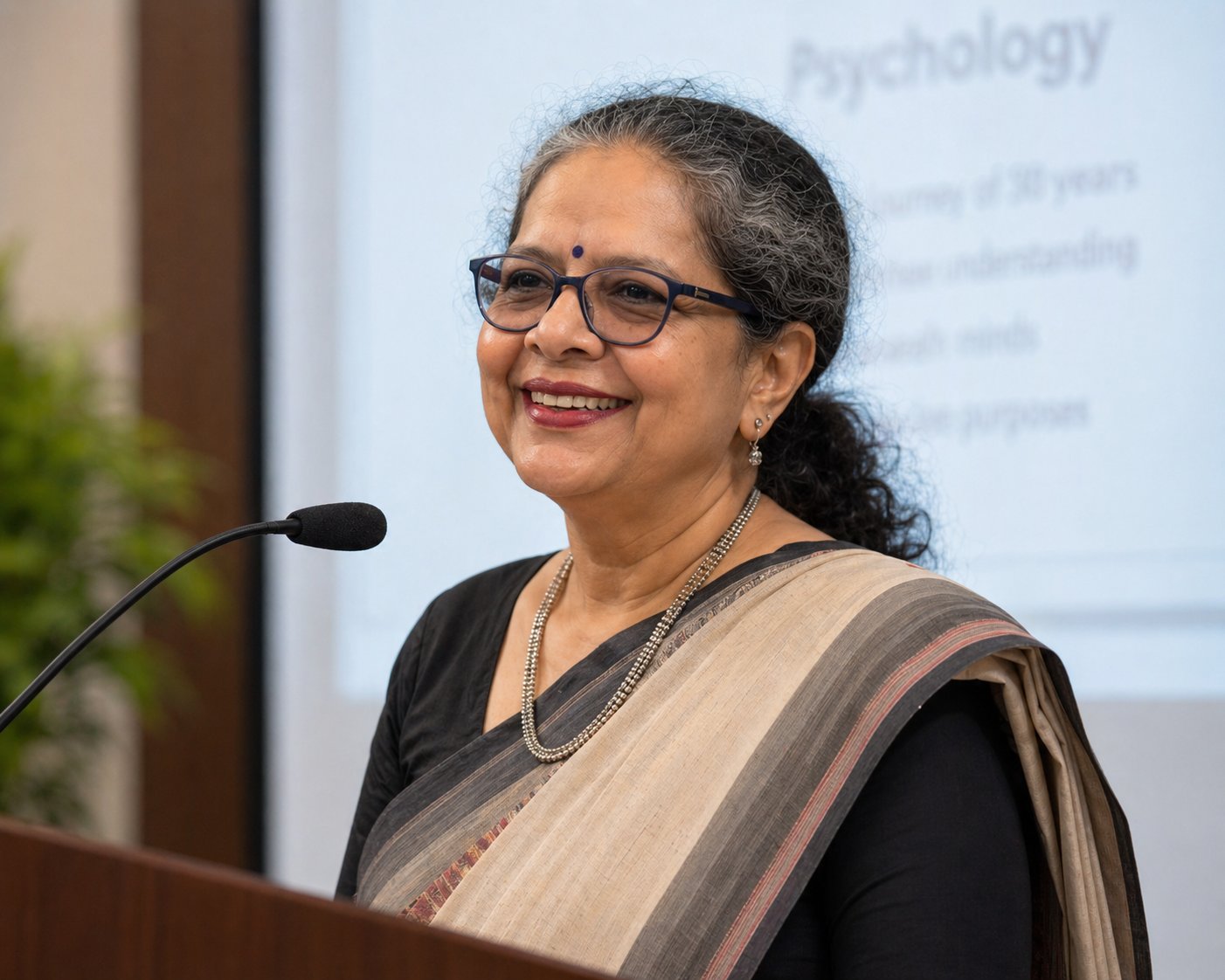
35 Years of Building a Practice — What South Delhi Has Taught Her
Anuradha has been practising in South Delhi since 1989. In those 35 years, the city has changed enormously around her — in its scale, its economy, its social composition, and the nature of the psychological challenges its residents face. But the fundamental human material has not changed. People still suffer in the same ways: grief, fear, loneliness, shame, the sense of not being enough, the weight of carrying too much for too long without support. And the capacity to heal remains the same: present, available, waiting for the conditions that allow it to unfold.
Over these decades she has trained in and integrated multiple therapeutic modalities. Counselling psychology was her foundation. Cognitive-behavioural therapy gave her precision — the capacity to target specific patterns systematically. Clinical hypnotherapy gave her depth — the capacity to access the subconscious layers where the patterns actually live. And past life regression, which she came to through her deepening interest in the layers of the unconscious mind that lie beyond even what conventional psychology typically maps, gave her scope — the capacity to work with dimensions of human experience that other therapeutic approaches do not reach.
She has adopted each modality not because it was fashionable or spiritually appealing, but because she saw it work — repeatedly, reliably, in the lives of people who had tried other approaches without finding what they needed. Her practice has always been guided by what helps, not by theoretical allegiance.
Her Mission — What She Is Doing and Why
Anuradha's mission has not changed in 35 years. She states it simply and without embellishment: to help people cleanse what is within, so they can live the full, meaningful lives they came here to live. Not just to manage their symptoms more effectively. Not just to cope better with a difficult reality. But to genuinely heal — to release the old patterns, the old wounds, the old fears — and to live with the openness, presence, and vitality that is every human being's natural state when the inner world is at peace.
She brings to this mission the rigour of a trained and experienced psychologist, the depth of a certified clinical hypnotherapist, the sensitivity of a practitioner who has sat with thousands of people in their most vulnerable moments, and above all, the warmth of a human being who has spent 35 years learning how to be genuinely, practically useful to the people who come to her.
She practises in South Delhi and online. She sees clients from across the city, across India, and from around the world. She works in English, Hindi, and Bengali. And she continues to learn — from her clients, from her own inner life, and from the ongoing mystery of what it means to be human.
If you are in South Delhi — or anywhere — and you are carrying something that feels too heavy to carry alone, she would like to help. The contact buttons on this page will reach her directly. She responds within 24 hours.
The Journey to Hypnotherapy — A New Dimension of Depth
It was through her training in clinical hypnotherapy that Anuradha's practice found what she describes as its deepest dimension. The California Hypnosis Institute of Delhi's training programme — rigorous, clinically grounded, miles from the popular representation of hypnosis as performance or entertainment — revealed a therapeutic modality of extraordinary precision. For the first time, she had a methodology that could reach the subconscious layers of the psyche that counselling and CBT could approach but not fully access: the early memories, the pre-verbal beliefs, the embodied patterns of emotion and response that live below the level of language and rational examination.
The clinical outcomes that consolidated her commitment were, as so often in medicine, the difficult cases — the clients whose difficulties had resisted years of conventional work, who came to her having tried everything else. The smoker of thirty years who had tried patches, gum, willpower, apps, and vaping as a stepping stone, and who stopped smoking permanently after six sessions. The woman with a phobia of water so severe she could not shower without panic, who swam confidently after three sessions of regression work that revealed an apparent origin in a previous lifetime's drowning. The senior executive whose imposter syndrome had survived two years of excellent CBT but dissolved in five hypnotherapy sessions targeted at the specific early experiences driving it. These were not coincidences. They were what happens when the right tool is applied to the right layer of the psyche.
Discovering Past Life Regression — The Last Modality She Expected
Past life regression was the last modality Anuradha integrated into her practice — and the one she had the most reservations about. Her training in clinical psychology had instilled a rigorous scepticism about claims that could not be empirically verified, and the popular culture representations of PLR gave her ample reason for caution. What changed her mind was not a philosophical argument but a clinical experience that she still speaks of with care and precision: a client with chronic back pain and recurring nightmares, both medically and therapeutically unexplained across years of treatment, who experienced complete resolution of both in two PLR sessions following experiences that appeared to be memories from a different lifetime.
This experience did not teach her that past lives are real in a literal sense. It taught her that the material that emerges in PLR sessions carries genuine therapeutic power — that working with it produces genuine clinical change — regardless of what that material actually is. This is the position she has maintained across 30 years of PLR practice: clinical openness combined with philosophical humility, in service of the therapeutic outcomes that are, in her experience, consistently and reliably real. She does not tell clients what to conclude. She provides the conditions for their own experience, and she trusts that experience — whatever form it takes — to be the guide.
Her Vision — What She Is Working Toward
Anuradha's vision for psychological wellbeing in South Delhi and beyond is not modest. She believes that the mental health of a community is as foundational to its flourishing as its physical health, its economic development, or its educational attainment — and that the current level of attention given to psychological wellbeing in India's public and professional life is far below what the evidence and the human cost warrant. She practises in South Delhi, sees clients online from across India and the world, trains informally through the quality of her clinical work, and contributes through writing and speaking to a larger cultural conversation about what it means to take the inner life seriously.
If you are in South Delhi — or anywhere — and you are carrying something that feels too heavy to carry alone, her invitation is simple and genuine: reach out. Use the contact buttons on this page. She responds within 24 hours. The session fee is Rs.2,000. The conversation that begins a therapeutic relationship does not require you to have your problem fully articulated or your goals clearly defined. It requires only the willingness to show up honestly and see what is possible.
What 35 Years Has Taught Her
If there is a single thing that 35 years of psychological practice in South Delhi has taught Anuradha Banerji Sarkar, it is this: the capacity for healing in the human being is consistently, reliably greater than the suffering that brings the person to the therapy room suggests. People arrive in the most extraordinary states of distress — grief that has lasted decades without resolution, anxiety that has reshaped an entire life around its demands, habits that have persisted despite years of determined effort to change them, wounds that have been carried since childhood without ever being named. And then, with the right conditions, the right therapeutic relationship, and the right tool applied to the right layer of the psyche, change happens. Not always dramatically. Not always quickly. But reliably, profoundly, in ways that last.
This consistency — the reliable encounter, across decades and thousands of clients, with the human capacity for healing — is what has sustained Anuradha's commitment to this work through all the challenges that 35 years of clinical practice inevitably brings. It is also what she wants for every person who reads this and recognises something of themselves in it: the encounter with their own capacity for healing. Whatever you are carrying, it is not permanent. It is not the truth of what you are. It is what happened — and what happened can be worked with, understood, released. The healing is possible. Anuradha has seen it too many times to doubt it. To begin, use the contact buttons on this page. She responds within 24 hours.