Women in Delhi carry an invisible load. The observation is not sentimental — it is clinical. The combination of professional expectation, domestic responsibility, social surveillance, emotional labour, and the management of other people's needs on top of their own unacknowledged inner experience creates a psychological environment that is, by any objective measure, extraordinarily demanding. At Anuradha Banerji Sarkar's South Delhi practice, women have always constituted the majority of clients. And in 35 years of working with them, the patterns she sees have not simplified — they have intensified.
Hypnotherapy offers women a particular kind of access. Not to a technique for managing distress — though it provides that — but to the deeper layers of their own inner lives that daily demands rarely leave space to acknowledge. This article explains how, and for what, it is most effective.
The Invisible Load — What Women in Delhi Are Carrying
The concept of the "mental load" — the cognitive and emotional labour of managing households, relationships, and family logistics — has entered public discourse in recent years. But for Delhi's women, the mental load is embedded in a cultural context that adds several additional dimensions of weight.
The professional woman in South Delhi is expected to be excellent at her career — she has fought for the right to that expectation and it is genuine and hard-won — while simultaneously being present, caring, and effective as a wife, daughter-in-law, mother, and family member. The social evaluation of women in Delhi is total and relentless: appearance, weight, age, professional success, marital status, the behaviour of children, the management of the household, the quality of food served at social occasions — nothing is outside the scope of social assessment. The gap between the many-sided performance required and the limited energy any individual human being actually has is where the psychological strain lives.
Beyond this, women in Delhi navigate specific cultural dynamics around voice and authority. Many high-achieving professional women describe a quality of double bind: assertiveness that would be valued in a male colleague is experienced, in them, as aggression or inappropriate assertiveness. The need to be simultaneously competent and non-threatening, ambitious and not-too-ambitious, confident and not arrogant, requires a constant micromanagement of self-presentation that is, in itself, a significant psychological burden.
The cumulative effect of all of this is a chronic, low-grade psychological exhaustion that many women have learned to normalise — to treat as simply the texture of their life rather than as a clinical reality that deserves and is amenable to therapeutic attention.
Why Hypnotherapy Is Particularly Effective for Women
Hypnotherapy's particular relevance for women lies in what it accesses. The conscious, verbal, analytical mind — the one that manages the calendar, navigates the relationships, maintains the performance — steps aside in the hypnotic state, and a different quality of the inner life becomes available. The part that has feelings she has learned to manage rather than express. The part that carries the early messages about what a woman is supposed to be and not be. The part where her own needs and desires live, quietly, beneath the more socially acceptable needs of everyone around her.
Many women in Delhi have developed what therapists describe as a highly competent external self — a version of themselves that is effective, together, and managing — alongside an inner life that is rarely given space or acknowledgement. The gap between these two selves is the source of a great deal of psychological distress. Hypnotherapy creates the conditions for the inner life to surface — safely, carefully, with a skilled and compassionate witness present — and for the gap between the external performance and the internal reality to begin to close.
What Women Come to Anuradha's Practice For
Anxiety and chronic worry is the most common presenting concern. The hypervigilant, always-on quality that many Delhi women describe as "just how I am" is not a personality trait. It is a learned response — sometimes going back to childhood, sometimes to the dynamics of their family of origin, sometimes to specific experiences that taught the nervous system that vigilance was necessary for safety. Hypnotherapy accesses the subconscious roots of this pattern and works to change it at the level where it was learned.
Confidence and self-worth — the persistent sense of not quite being enough, regardless of achievement — is particularly common among high-achieving women. The impostor syndrome that appears in professional settings, the difficulty receiving praise or acknowledging accomplishment, the tendency to attribute success to luck or others while attributing failure to personal inadequacy — these patterns have specific subconscious roots that hypnotherapy can address directly and effectively.
Relationship patterns — particularly the tendency to attract or remain in relationships in which one's needs are consistently subordinated to another's — is a common presenting concern with deep roots. The subconscious beliefs about what love looks like, about what one deserves in a relationship, about the danger of having needs that might inconvenience others — these beliefs were typically formed long before the current relationship and are maintained at a level below conscious intention. Hypnotherapy accesses and changes them.
Fertility-related anxiety and pregnancy loss carry a particular weight in Delhi's cultural context, where the pressure around fertility is significant and the grief of miscarriage or pregnancy loss is typically processed in isolation. Hypnotherapy and counselling together provide a comprehensive support — addressing both the psychological dimensions of anxiety around fertility treatment and the genuine grief that pregnancy loss produces.
Perimenopausal and menopausal anxiety is an increasingly recognised but still under-supported area of women's psychological health. The hormonal changes of perimenopause interact with identity questions — particularly for women whose primary roles have been as mothers or whose careers are entering transition — to produce a form of anxiety that is both physiological and existential. Hypnotherapy is effective for the anxiety component; counselling for the identity and meaning dimensions.
Body image and relationship with food — from the pervasive low-grade body dissatisfaction that social media sustains, to the more entrenched patterns of emotional eating or restriction — responds well to the combination of hypnotherapy (addressing the subconscious emotional drivers) and CBT (building conscious strategies for a different relationship with food and body).
Safety, Confidentiality, and the Specific Concerns of Women Clients
Many women who consider therapy in Delhi have specific concerns about privacy — about family members knowing they are seeking support, about the stigma that some communities still attach to psychological help, about the confidentiality of what they share. These concerns are completely understandable and deserve a direct response.
All sessions with Anuradha — whether in-person or online — are bound by strict professional confidentiality. Nothing you share in a session is disclosed to anyone — family, spouse, employer, or community — without your explicit written consent. The only exceptions are very specific legal circumstances (such as imminent risk of serious harm to oneself or another), which Anuradha explains clearly at the outset of any therapeutic relationship.
For women who are concerned about being seen entering a clinic — a legitimate concern in some Delhi communities — online sessions provide complete privacy. You can access support from your own home, your office, or any private space, without anyone knowing. The therapeutic quality of online sessions is fully equivalent to in-person work.
Working with Women Across Generations — A Distinctive Practice
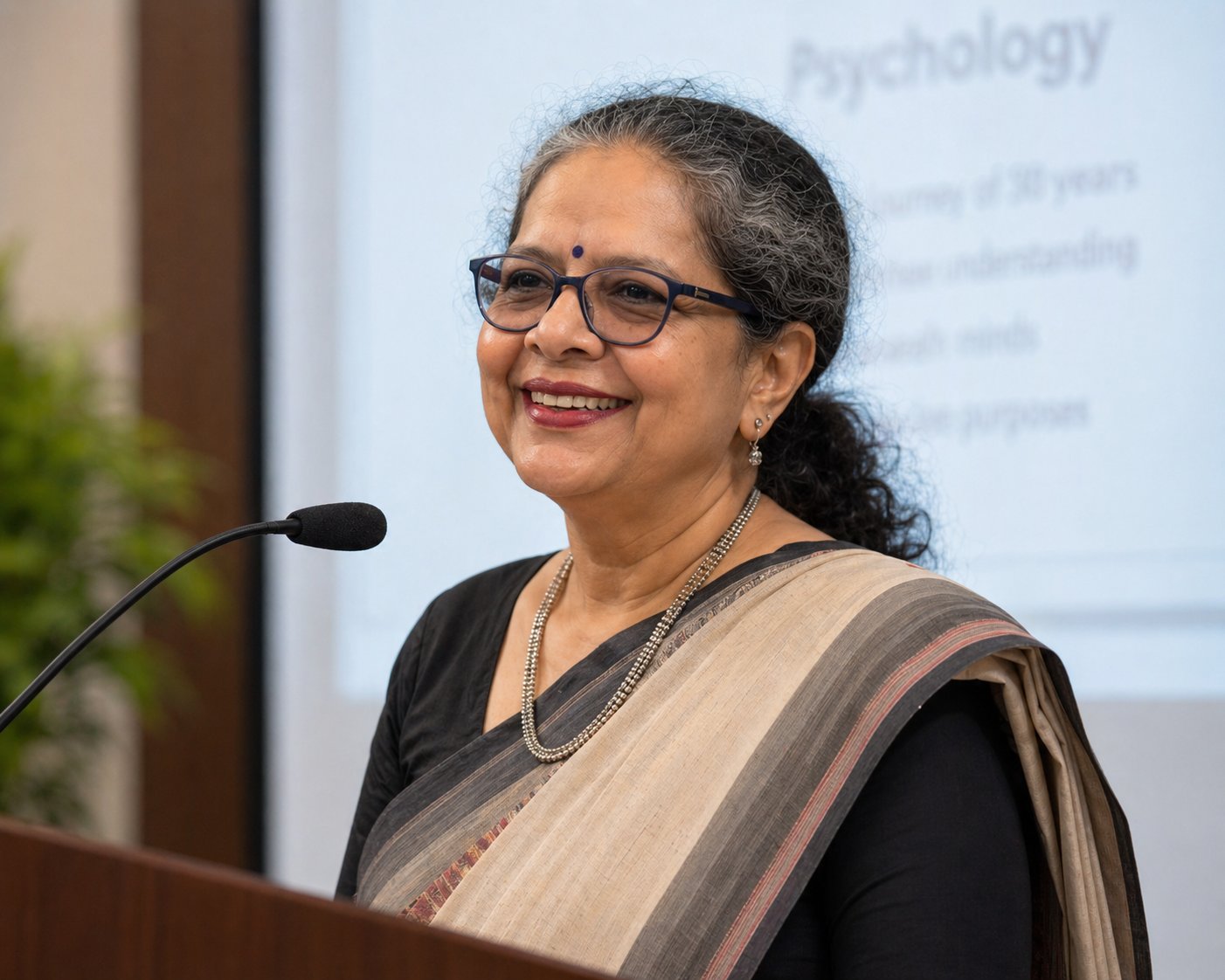
One of the distinctive features of Anuradha's practice in South Delhi is her experience working with women across the full life span: from young women in their twenties navigating early career decisions and first relationships, through the middle years of marriage, motherhood, career development, and family management, to the later years of transition, loss, and the search for meaning beyond roles. This multi-generational perspective gives her clinical work with women a depth of understanding of the arc of a woman's life that is difficult to replicate without this breadth of experience.
She also frequently works with women from different generations of the same family — a mother and her adult daughter, for example, each working on their own individual material, but with the shared understanding of a family system and its particular patterns that makes both therapeutic journeys more productive.
Booking a Session in South Delhi
Anuradha sees clients in-person at her South Delhi practice (accessible from Saket, GK, Malviya Nagar, Defence Colony, Hauz Khas, and across South Delhi) and online for women across Delhi NCR, India, and internationally. Sessions are ₹2,000 per 60 minutes. Hindi, English, and Bengali sessions are available. Use the contact buttons on this page to reach out — discreetly, directly, in whichever way feels most comfortable.
The South Delhi Context — What Women Navigate Here
South Delhi's social environment has particular characteristics that shape women's psychological experience in specific ways. The social circles of GK, Vasant Vihar, Saket, and Hauz Khas are simultaneously more progressive and more surveilled than almost anywhere else in India: more likely to support women's professional ambitions while simultaneously more attentive to their appearance, lifestyle choices, relationship status, parenting style, and the maintenance of a visible, well-curated life. The pressure to appear to be doing it all effortlessly — career, family, social presence, physical appearance — is, in these communities, remarkably and specifically intense.
The form of psychological distress this produces is what Anuradha describes clinically as "curated exhaustion": the exhausting work of maintaining the appearance of a life that looks like enough, while never actually resting in the feeling of enough. Hypnotherapy is particularly effective for this pattern because it can reach the subconscious beliefs — formed in childhood, in response to early messages about what female worthiness looks like — that make the sense of being enough structurally unavailable through performance alone. No amount of achievement changes the feeling of inadequacy when the inadequacy lives in the subconscious operating system rather than in the objective record of what has been accomplished.
Confidentiality and Safety — Specific Concerns for Women Clients
Many women who consider seeking therapy in Delhi have specific concerns about privacy and confidentiality — about family members knowing they are seeking support, about the stigma that some communities still attach to psychological help, or about the specific risks involved in acknowledging difficulties within marriages or family systems where such acknowledgement could have practical consequences. These concerns deserve direct and honest acknowledgement rather than reassurance that underestimates the social realities involved.
All sessions with Anuradha — whether in-person or online — are bound by strict professional confidentiality. Nothing shared in a session is disclosed to anyone, including family members, spouse, employer, or community members, without explicit written consent. The only exceptions are very specific legal circumstances, which Anuradha explains clearly at the outset of any therapeutic relationship. For women who are concerned about being seen entering a clinic, online sessions provide complete privacy: accessible from home, office, or any private space, with no external indication of what the appointment is. Sessions are available in English, Hindi, and Bengali. Rs.2,000 per session. Response within 24 hours.
Hypnotherapy and Hormonal Health — An Often Overlooked Connection
The relationship between psychological stress and hormonal health in women is well-documented and clinically significant. Chronic psychological stress produces sustained elevation of cortisol that directly disrupts the hypothalamic-pituitary-ovarian axis — the hormonal cascade governing menstrual regularity, fertility, and the transition into perimenopause. Many women in South Delhi who present with unexplained menstrual irregularity, fertility challenges that have not been adequately explained by medical investigation, or particularly difficult perimenopausal symptoms are experiencing the direct hormonal consequences of chronic psychological stress that has not been addressed.
Hypnotherapy contributes to hormonal health not through any direct hormonal action but through its regulation of the nervous system state that is driving the cortisol elevation. As the chronic hyperarousal pattern resolves through therapeutic work, the hormonal cascade that it disrupts begins to normalise. This is not a substitute for medical investigation and treatment of hormonal conditions — it is a genuinely useful complement to it that many of Anuradha's clients have found produces measurable improvements in hormonal symptoms alongside their primary therapeutic goals.
Practical Next Steps for Women in South Delhi
If any of what this article describes resonates with your experience — whether it's the anxiety that has become background noise, the confidence that feels fragile underneath the professional performance, the relationship pattern you keep finding yourself in, or simply the persistent sense that you are carrying more than you should be carrying alone — the beginning is straightforward. Use the WhatsApp or email buttons on this page. Anuradha or her team will respond within 24 hours. The session fee is Rs.2,000 per 60 minutes, in-person in South Delhi or online. Sessions are available in English, Hindi, and Bengali. You do not need to have your situation fully articulated before you reach out. A brief initial conversation is enough to begin to understand whether and how Anuradha's practice can be useful for you.
Working With Women Across Generations — A Distinctive Strength
One of the most distinctive features of Anuradha's practice in South Delhi is her experience of working with women across the full span of adult life — from young women in their twenties navigating early career decisions and first relationships, through the middle years of professional development, marriage, motherhood, and family management, to the later years of transition, grandmotherhood, the death of parents and sometimes spouses, and the search for meaning beyond roles. This multi-generational perspective gives her clinical work with women a depth of understanding of the arc of a woman's life in Delhi's specific cultural context that is difficult to replicate without this breadth of experience. When she sits with a woman in her late fifties navigating the death of her husband, she brings understanding of the entire developmental arc that preceded this moment. When she sits with a woman in her early thirties navigating her first pregnancy, she brings the clinical perspective of having seen hundreds of women navigate the same transition across three decades. This depth is one of the most consistent reasons that women return to her practice across years, and refer members of their own families. Use the contact buttons on this page to book.
You Do Not Have to Carry This Alone
The most important thing Anuradha wants women reading this to understand is this: the psychological load you are carrying — whatever form it takes, whatever name it has — does not have to be carried alone. Not because help is available in an abstract sense, but because specific, skilled, culturally informed, genuinely compassionate help is available here, in South Delhi and online, from a practitioner who has spent 35 years learning how to be useful to women in exactly the situations this article describes. The load does not have to be this heavy. The inner life does not have to feel this difficult to access. The sense of enough does not have to remain perpetually out of reach. The first step is straightforward: use the contact buttons on this page. Anuradha responds within 24 hours. Rs.2,000 per 60-minute session. In-person in South Delhi and online anywhere in India or the world. Hindi, English, and Bengali. You are welcome exactly as you are, with whatever you are carrying, at whatever stage you are at.