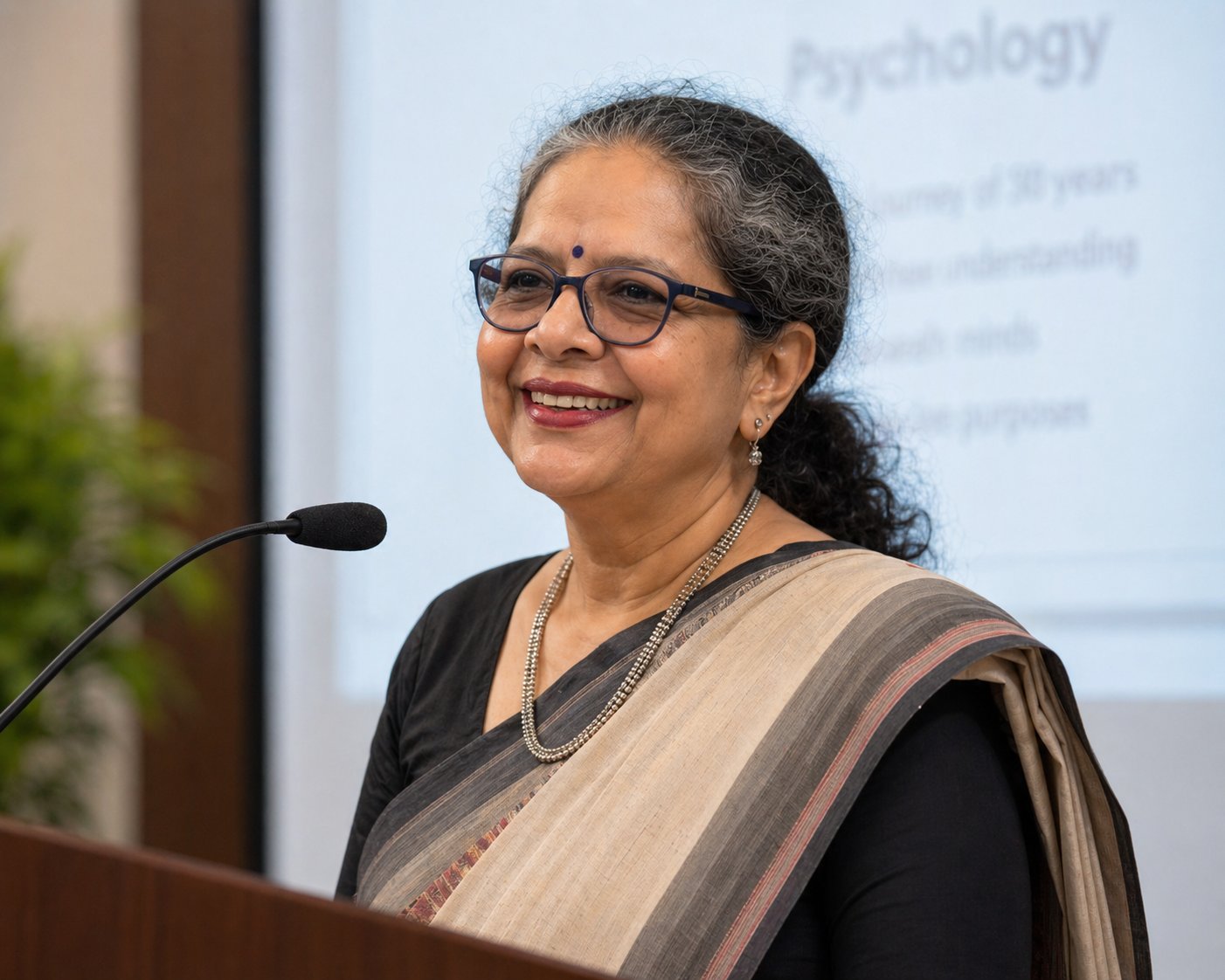
If you are looking for a psychologist, therapist, or counsellor in Saket or South Delhi, this guide is designed to give you the most complete and honest account of what to look for, what is available, and how to make the right choice. It is written by Anuradha Banerji Sarkar — who has been practising in South Delhi for over 35 years — and draws on three and a half decades of experience working with clients from every part of the city.
Finding the right therapist is one of the most important decisions you can make for your psychological wellbeing. The evidence is unambiguous: the quality of the therapeutic relationship — the degree of trust, understanding, and genuine connection between client and therapist — is the single most powerful predictor of therapeutic outcome, more powerful than any specific technique or modality. Getting this choice right is worth the time and care it takes.
The South Delhi Psychological Care Landscape
South Delhi has become one of the most concentrated areas for psychological services in India. The density of educated professional families, the presence of major hospitals including Max Saket, Fortis Vasant Kunj, and Apollo, the proximity to embassies and international institutions, the affluence of neighbourhoods like Vasant Vihar, Greater Kailash, and Saket — all have contributed to a robust and varied ecosystem of psychological care.
Saket in particular has developed as a hub. The Select Citywalk catchment area, the proximity to Max Saket Hospital, the large residential communities of Saket and Malviya Nagar — these create a natural concentration of both supply and demand for quality psychological services. Clients in Saket are, on average, well-informed about their options, accustomed to research before they choose, and expecting a high standard of both clinical quality and personal care.
The challenge in Saket and South Delhi, as anywhere, is distinguishing between practitioners whose credentials and experience actually deliver what they promise, and those whose online presence is more polished than their clinical reality. The psychological services market in Delhi, as in many cities, has expanded rapidly and without perfect quality control. Knowing what to look for is essential.
What Credentials Actually Matter — and What to Ask
The minimum qualification for a legitimate psychologist practising in India is a postgraduate degree — an MA or MSc in Psychology, Clinical Psychology, or Applied Psychology — from a recognised university. Some practitioners hold MPhil or PhD qualifications, which indicate additional depth of training. For hypnotherapy specifically, a certification from a recognised clinical hypnotherapy training organisation (not a weekend course) is required.
Beyond qualifications, experience matters enormously in psychological work. The skills of therapeutic listening — knowing when to ask and when to be silent, how to hold space for difficult material, how to read what is not being said — develop only through hundreds of hours of supervised clinical practice and years of direct client work. A practitioner with five years of experience is still developing. One with 20 to 35 years brings a qualitative depth that certification alone cannot replicate.
When you first speak with a potential therapist, it is entirely reasonable to ask: What are your qualifications? How long have you been practising? What approaches do you use? Have you worked with clients presenting with similar concerns to mine? How do you structure the initial sessions and the ongoing work? A practitioner who is confident in their competence and their approach will answer these questions directly and without defensiveness.
Anuradha Banerji Sarkar holds an MSc in Psychology from Kolkata University, is a certified clinical hypnotherapist trained through the California Hypnosis Institute of Delhi, and has been practising in South Delhi since 1989. She works with clients from Saket, Greater Kailash, Malviya Nagar, Lajpat Nagar, Defence Colony, Hauz Khas, Vasant Vihar, and across Delhi NCR.
Types of Therapy Available in South Delhi
South Delhi offers access to a broad range of therapeutic modalities. Understanding what each offers helps you identify what is most appropriate for your situation.
Counselling Psychology is the most accessible entry point into psychological care. It provides an open, non-judgmental therapeutic conversation — a space to process difficult experiences, explore emotional patterns, and develop greater self-understanding. Unlike more structured approaches, counselling is led primarily by what the client brings, at the pace the client sets. It is suitable for virtually any presenting concern and is the right starting point if you are new to therapy or if you are not yet sure what kind of help you need.
Cognitive Behavioural Therapy (CBT) is the world's most researched psychological treatment, with strong evidence across anxiety, depression, OCD, PTSD, phobias, and performance challenges. It is structured, skill-based, and involves active between-session homework. It works best for clients who are comfortable with a more defined framework and who are motivated to engage actively with the therapeutic tasks. In South Delhi's high-achievement environment, CBT is particularly valued by professionals and students who want a method with clear, measurable progress.
Clinical Hypnotherapy works at the subconscious level — below the rational, verbal, conscious mind — reaching the deeper patterns, beliefs, and memories that drive behaviour and emotion. It is particularly effective for habits (smoking cessation is a very common request), phobias, anxiety, confidence, insomnia, and — in combination with regression — for patterns that appear to have deep or pre-conscious origins. Clinical hypnotherapy should not be confused with stage hypnosis; it is a serious, rigorous, clinically supervised therapeutic modality.
Past Life Regression extends hypnotherapy's scope to material beyond the current lifetime. Anuradha is one of South Delhi's most experienced PLR practitioners, and clients travel from across Delhi and India — and internationally — specifically for this work.
How to Make the Right Choice for You
The most useful framework for choosing a therapist in South Delhi is not to optimise for credentials, or modality, or even proximity — though all of these matter. It is to optimise for fit. The research evidence is consistent: a therapist who is genuinely right for you, with whom you feel safe, understood, and not judged, will produce better outcomes than a more technically accomplished therapist with whom you feel uncomfortable or not fully seen.
This means that the first session is partly a professional assessment of you and your presenting concern — and partly your own assessment of whether this is someone you can work with. You are entitled to this assessment. You are not obliged to return if the first session does not feel right, even if the practitioner is highly qualified and well-regarded. Therapeutic relationship is personal.
Equally important is cultural fit. Many clients in South Delhi have found it valuable to work with a therapist who understands the specific cultural context of their life — the family dynamics, the social expectations, the particular pressures of the community and the city. Anuradha's 35 years of practice in South Delhi has given her a deep familiarity with this context that is itself therapeutically valuable.
In-Person vs Online Therapy in Saket and South Delhi
One of the most practically significant questions for South Delhi clients is whether to pursue in-person or online sessions. The research does not clearly favour either format for most presenting concerns — online CBT, counselling, and even hypnotherapy have all been shown to produce outcomes comparable to in-person work when conducted well. The therapeutic relationship quality, which matters most, can be established and sustained online.
The practical case for online therapy in Delhi is strong: it eliminates commute time (which from Gurgaon or Noida can be 45–90 minutes each way), enables sessions during work breaks or travel, removes weather-related barriers during Delhi's extreme seasons, and opens access to the practitioner of your choice regardless of where in the city or country you happen to be based.
The case for in-person work is equally real for some clients — particularly for those who find the embodied, room-sharing quality of in-person sessions irreplaceable, or for intensive modalities like past life regression where the physical environment of the session contributes to its depth. Anuradha offers both, and is happy to discuss which is likely to be most valuable for your specific situation.
What to Expect in Your First Session with a Saket/South Delhi Psychologist
The first session with Anuradha is not therapy. It is an assessment and a getting-to-know. She spends the majority of the first session listening — understanding who you are, what brings you in now, what your history looks like, what you are hoping for. She will not rush to diagnose or to prescribe a treatment plan. She will not offer advice unless you specifically ask for it. She will not make you feel judged, assessed, or managed.
By the end of the first session, you should have a sense of whether this is a person you can work with. You should feel, at minimum, that you have been genuinely heard — that what you brought into the room was received with care, without the sense that your experience was being fitted into a predetermined category. You should have a clearer sense of what the work might look like and what your next steps are.
If you do not feel this after a first session, that information is valuable. It is not a judgement of you or necessarily of the therapist — it may simply mean the fit is not right. Anuradha is clear with prospective clients: the goal of the first session is to establish whether the therapeutic relationship is viable, not to lock anyone into a commitment.
Booking a Session in Saket or South Delhi
Anuradha's South Delhi practice is open Monday to Saturday, 10 AM to 7 PM. Sessions cost ₹2,000 per 60 minutes. Online sessions are available at the same rate for clients across Delhi NCR — Gurgaon, Noida, Faridabad, Ghaziabad — and internationally. Sessions are conducted in English, Hindi, and Bengali. Sunday sessions are available by prior appointment. To book, use the WhatsApp or email buttons on this page. Anuradha or her team will respond within 24 hours.
The Saket Community — Its Specific Psychological Context
Saket occupies a particular position in South Delhi's social geography that shapes the psychological needs of its residents in distinctive ways. The area combines some of the city's most upmarket residential development with significant proximity to major healthcare infrastructure — Max Hospital Saket being one of Delhi's most prominent private hospitals — and the commercial and social hub of Select Citywalk. This combination produces a community that is simultaneously highly health-aware and socially performative, with access to excellent medical care and a well-developed expectation of quality professional services in general.
The residents of Saket's residential colonies — Pushp Vihar, Malviya Nagar adjacent, and the upmarket apartments near the Select Citywalk corridor — include a significant proportion of young and mid-career professionals, NRI families who have returned to India, and established business families. Each of these groups brings its own psychological profile. The young professionals navigate the pressures of performance and the gap between the aspirational lifestyle that Saket's social environment suggests and the financial and personal realities they are actually managing. The NRI returnees navigate the particular psychological complexity of re-entry — of belonging to Delhi differently than they once did. The established families navigate the specific dynamics of wealth, succession, and the management of a social identity that requires ongoing maintenance.
Medical Referrals Near Saket — When to See a Psychologist Alongside Medical Care
The proximity of Max Saket Hospital makes Anuradha's South Delhi practice a natural complement to the medical care available in the area. Many clients come to her through referral from General Physicians, cardiologists, gastroenterologists, and other medical specialists who have identified psychological components in their patients' presentations. The patient with IBS whose gastroenterologist has found no structural cause. The cardiac patient whose anxiety about their heart is producing palpitations that further complicate their medical picture. The patient with chronic pain whose physical management is being significantly complicated by the psychological dimensions of their condition.
In these cases, Anuradha works alongside the medical team — not as a substitute for medical care but as the complementary psychological support that makes the medical care more effective. She maintains appropriate communication with referring clinicians (always with the client's explicit consent) and structures her therapeutic work to complement rather than conflict with any medical treatment the client is receiving. For many clients near Saket, this integrated approach — addressing the whole person rather than the symptom — produces outcomes that neither medical care nor psychological care alone could achieve.
Practical Information for Saket and South Delhi Clients
Anuradha's South Delhi practice is accessible from Saket, Malviya Nagar, Greater Kailash, Hauz Khas, and across South Delhi by car or auto. For clients who prefer online sessions — including those in Noida or Gurgaon, or those who find midday appointments easier without the commute — all services are fully available online. Sessions are Rs.2,000 per 60 minutes. The practice is open Monday to Saturday, 10 AM to 7 PM. Sunday sessions are available by prior appointment. Hindi, English, and Bengali sessions are available. To book or discuss your situation, use the WhatsApp or email buttons on this page. Anuradha or her team respond within 24 hours.
How to Know If You Have Found the Right Therapist
The question of how to know if you have found the right therapist — as opposed to simply a competent one — is one that Anuradha answers directly with new clients. The markers are partly rational: do they seem genuinely knowledgeable, do they explain their approach clearly, do they answer your questions directly? But they are mostly felt: do you leave the first session feeling less alone than when you arrived? Do you feel that what you brought to the room was genuinely received — not assessed, not categorised, not fitted into a framework, but actually received, with care and without judgment? Is there a quality of being seen, specifically and accurately, that is distinct from being understood in a general way?
These felt markers are not soft criteria. They are the primary predictors of therapeutic outcome, and they are what Anuradha aims to produce in every first session. If after a first session with any therapist in Saket or South Delhi you do not feel this quality — if you feel assessed rather than heard, managed rather than met — that information is worth attending to. The therapeutic relationship is personal, and the right fit matters more than any credential or technique. Anuradha's South Delhi practice is open to initial consultations with no commitment required — a single first session to assess fit, at the same Rs.2,000 per session rate, after which both therapist and client decide together whether and how to proceed. Use the contact buttons on this page to begin. Response within 24 hours.